
Beyond Chatbots: Why Autonomous AI Agents are the Future of Business
Let's be honest. You've probably heard of ChatGPT by now. Maybe you've even used it yourself — asked it to write an email to a client or draft a quarterly plan. And, most likely, you thought: "Well, it's a cool thing, but where is the real value for my business?"
And you know what? You were right.
The AI you chatted with is, essentially, a very smart consultant sitting in the corner, waiting for you to come to them. It will give advice, write text, and even propose a strategy. But it can't actually do anything — send an email, update a CRM, or order a product. All of that was still up to you and your team.
But now, something fundamentally different has emerged. A technology that doesn't just "think", but acts. It's called Agentic AI. And that's exactly what we want to talk to you about — without the technical jargon, in plain language.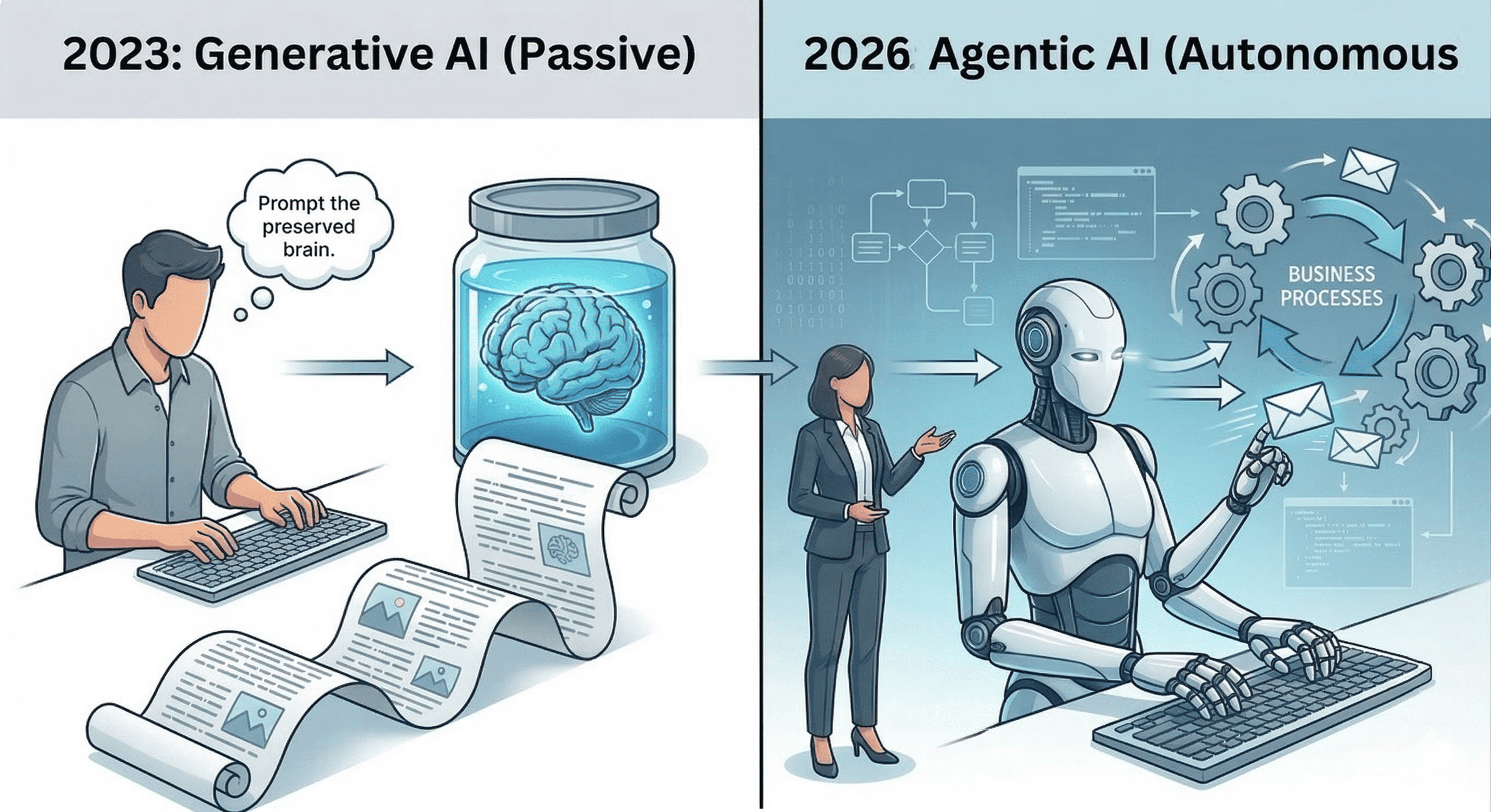
Okay, so what is an "agent"?
Imagine two employees.
The first one is a super-smart intern. They've read all the books and know the answer to any question. But they literally sit at their desk waiting for you to approach them. Ask a question — they answer. Don't ask — they stay silent. And most importantly: they don't do anything on their own. You tell them "write a reply to the client" — they write it. But opening the email, finding the address, and clicking "send" — that's all on you. This is what ChatGPT has been until recently.
The second one is an experienced executive assistant. They also know a lot, but most importantly — they have access to your email, calendar, and CRM system. You tell them: "Organize my trip to a conference in London." And they independently check your calendar, look for tickets, book a hotel, and tell you: "Everything is ready. The flight is at 7:15, the hotel is 10 minutes from the venue. Confirm?"
That is the difference. The first is a chatbot. The second is an agent.
In simple terms: A chatbot answers questions. An agent solves the task from start to finish.
And how does it work? (Explaining without unnecessary complications)
Don't worry, we won't dive into neural networks. But understanding the general logic is useful — if only to ask contractors the right questions.
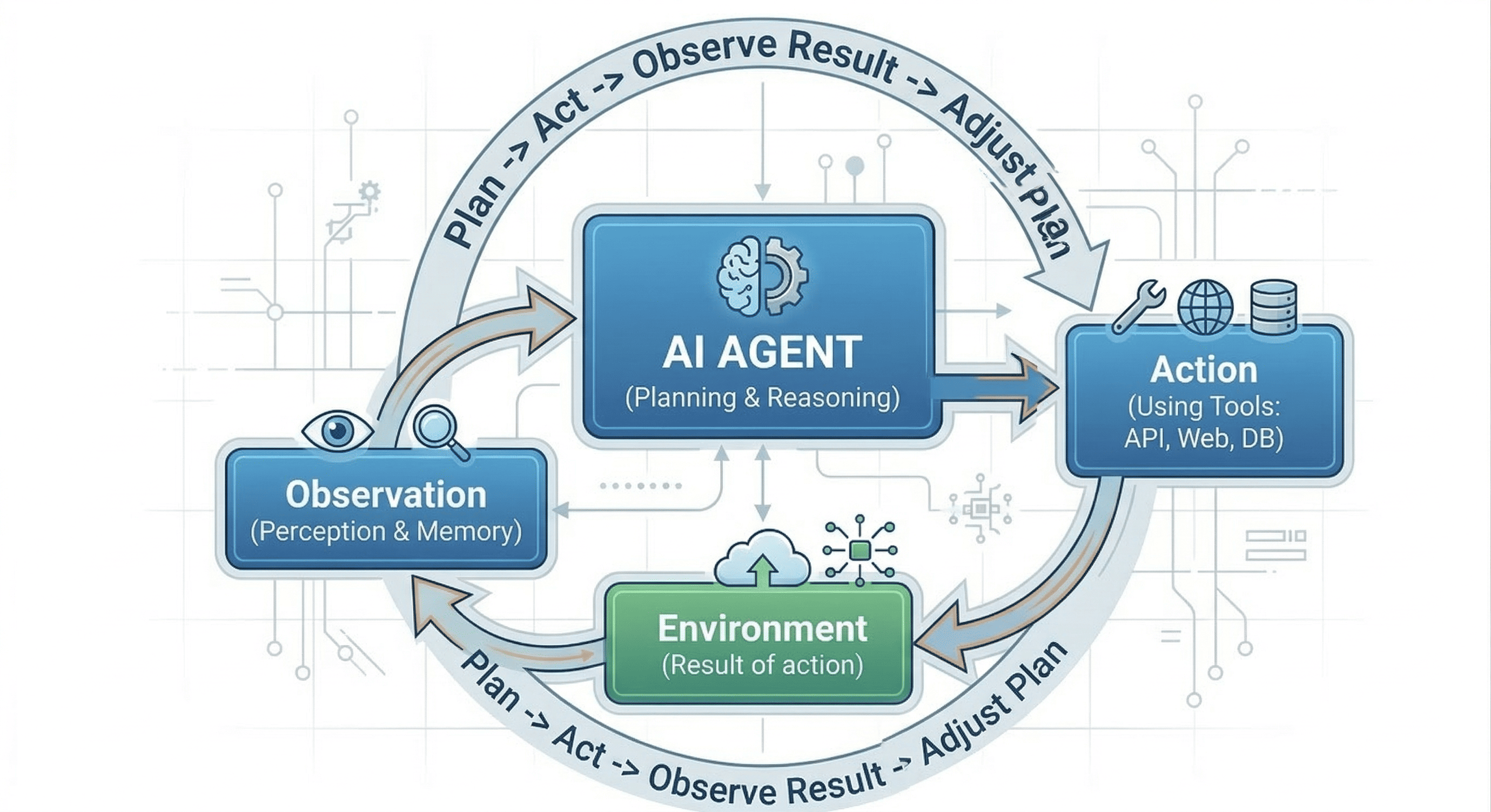
An agent works on a simple cycle, like a good manager:
And all of this — without bothering you at every step.
Why is this important right now?
You might be thinking: "My business works fine without AI. Why do I need this?" Let's look at four specific things that agents change.
Your business works even when everyone is sleeping
A client left a request at 3 AM? The classic scenario: a manager sees it at 9 AM, calls after lunch, and the client has already gone to a competitor. An agent processes the request a minute after it arrives — at 3 AM, on a weekend, or on a holiday. Without sick days or vacations.
Scaling without the headache
High season, a promo campaign, a sudden influx of orders. Usually, this means a rush job, mistakes, and dissatisfied clients. An agent handles the load: processing 10 orders or 1000 — makes no difference to it. And after the season is over, you don't need to fire anyone.
No more "forgot" and "didn't have time"
People make mistakes — it's normal. Especially when a manager is simultaneously handling 30 clients, answering calls, and filling out spreadsheets. An agent doesn't mix up orders, doesn't forget to update the CRM status, and doesn't "accidentally" send an invoice to the wrong client.
Problems are solved before you even know about them
An agent doesn't just wait for instructions. It sees that a popular item is running out of stock — and orders it itself. It sees that a server is starting to lag — and notifies tech support. It's like having a manager who is always one step ahead.
Real examples: what it looks like in practice
It sounds great, but how does it work in real life? Here are four examples from different business sectors.
Private clinic
The problem: The reception desk is overwhelmed in the morning. Patients book appointments with the wrong doctor, or worse, they don't show up — and the clinic loses money.
What the agent does: Communicates with the patient in a messenger, asks about symptoms, determines the right specialist, and books the visit itself. If someone cancels an appointment, the agent instantly finds another patient from the waiting list and offers the available time slot.
The result: Doctors are 98% booked. The workload on the reception desk has dropped by almost half.
Wholesale online store
The problem: Managers either forget to order a popular product (and it goes out of stock) or order too much (and money is tied up in inventory).
What the agent does: Constantly monitors stock levels. Sees that a product is running low — independently contacts suppliers, compares prices, and places an order.
The result: Shortages of top products have decreased by 60%. Instead of taking three days for procurement, it takes 15 minutes.
Property management company
The problem: Tenants complain that repairs take forever. Dispatchers get confused with requests, and repair workers arrive late.
What the agent does: A tenant sends a photo of the breakdown. The agent identifies the problem, finds the right repair worker, coordinates the time, and collects documents for the report after the repair is done.
The result: Emergency response time dropped from 4 hours to 10 minutes.
Furniture factory
The problem: It takes a week from receiving a custom order to putting it into production — paperwork, approvals, bureaucracy.
What the agent does: A manager uploads a blueprint — in seconds, the agent generates a list of parts, checks what's in stock, orders what's missing, and puts the order in the production queue.
The result: Processing takes 20 minutes instead of 5 days. The factory started producing 15% more.
An honest conversation about risks
It would be unfair to only talk about the benefits. Agentic AI is a powerful tool, and like any powerful tool, it requires a smart approach.
First, an agent can make a mistake — and it won't just be silly text. When a regular chatbot writes nonsense, you smile and fix it. When an agent makes a mistake, it might order the wrong quantity of goods or send the wrong invoice. Therefore, a proper implementation always includes a system of "safeguards": the agent acts only within strict boundaries and asks for confirmation at critical stages.
Second, this is not an out-of-the-box product. You can't just "buy an agent" and turn it on like a new app on your phone. Every business is unique, and the agent must be customized to your specific processes, systems, and rules. It's an engineering project, not a subscription purchase.
Third, security. If an agent has access to your systems, that access must be protected. We build multi-level security systems that guarantee the agent only does what it's allowed to do and never oversteps its boundaries.
What's next?
Agentic AI is not science fiction or a buzzword for presentations. It is a technology that is already working and delivering concrete results to real companies.
The question is not whether this technology will come to your industry. It's already here. The question is who will use it first — you or your competitors.
And no, you don't need to understand all the technical details. You need a team that will figure it out for you, ask the right questions, and build a solution tailored to your business.
Want to find out where an agent will have the biggest impact on your business?
Contact our team. We will conduct a free audit of your processes, show you where automation will yield the highest return on investment, and design a solution specifically for your tasks.
